Thailand: A Safe Harbor for the Family in a Volatile World
Don’t look for a house. Choose the country that will become home.
salvatore parisi
3/4/20266 min read
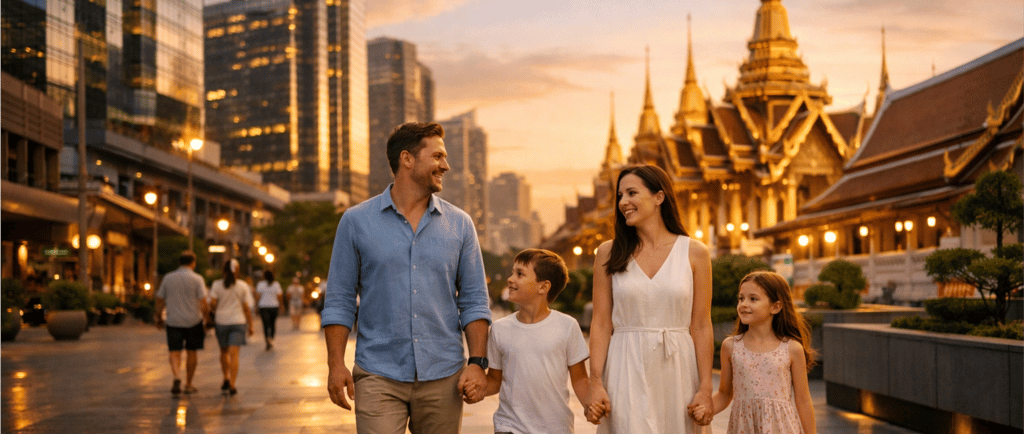
In the international real estate market of 2026, an increasingly clear paradigm shift is taking shape. The sophisticated investor no longer starts from the search for the perfect property, but from a far more strategic question: in which country does it make sense to position one’s capital and, potentially, one’s life?
For years, attention focused almost exclusively on the property itself — location, size, sea view, price per square meter. Today, this approach is no longer sufficient. Geopolitical tensions, economic volatility, and the growing mobility of capital are pushing investors to think in terms of country strategy even before real estate investment.
In this scenario, Thailand emerges as one of the most compelling answers — not because of absolute neutrality, but due to a unique combination of geopolitical pragmatism, economic resilience, and quality of life.
Thai “Geopolitical Neutrality”: Myth or Reality?
The label “Switzerland of Southeast Asia” has been used for decades, but it must be put into context.
Where the comparison holds
History of Non-Colonization
Thailand (formerly Siam) is the only country in Southeast Asia never to have been colonized by a European power. This is the root of its diplomatic skill: for centuries it has deftly balanced the demands of the French and the British, playing them against each other. This art of balancing is in its DNA.
“Bamboo” Foreign Policy
Thai diplomacy is often described as that of bamboo — bending with the wind but never breaking. Historically, it has always sought alignment with the dominant power to preserve its sovereignty.
Position in Today’s World
Today, Thailand continues this policy. It is a key ally of the United States while also maintaining deep economic ties with China. It preserves strong relations with Russia and the Arab world. This flexibility allows it to avoid taking rigid positions that could harm its economy, which is heavily based on tourism and investment.
Where the comparison is weaker
“Active” vs. “Passive” Neutrality
Swiss neutrality is a legal and permanent concept. Thailand’s is better described as active neutrality or pragmatic non-alignment, decided case by case.
Internal Instability
Unlike Switzerland, Thailand has a turbulent internal political history. Coups, revoked constitutions, and street protests are part of its recent past.
Regional Conflicts
Thailand is not completely free from tensions, with an ongoing separatist insurgency in the southern provinces.
Thailand is not neutral in the strict Swiss sense, but it is exceptionally skilled at neutralizing external threats through flexible diplomacy. In a volatile world, this ability to avoid major conflicts is a significant asset.
Beyond Geopolitics: Thailand as an Everyday Safe Harbor
If geopolitical neutrality is pragmatic rather than absolute, it is in daily life that Thailand shows its true nature as a safe haven.
Stability and Personal Security
Thailand boasts a surprisingly low crime rate compared with many investment destinations. It is common to see women and girls walking alone late at night — a powerful indicator of how respectful and peaceful society is. Violent crimes against foreigners are rare, and even petty crimes such as pickpocketing or opportunistic theft are less frequent than in many Western cities.
This everyday safety allows families to live with peace of mind, knowing their children can move freely and that a wife or daughter can return home in the evening without anxiety. At a time when perceived insecurity is rising in many global metropolises, this factor has immeasurable value.
Why Thailand Works for Families
High-Level International Schools
Bangkok, Chiang Mai, Phuket, and Pattaya host dozens of international schools offering British, American, and IB (International Baccalaureate) curricula. The quality of education is comparable to Western standards, but tuition fees are significantly more affordable — often 40% to 60% lower than equivalent schools in Europe or North America. This opens educational opportunities that would be prohibitive elsewhere for many families.
Excellent Healthcare for the Whole Family
Thai hospitals such as Bumrungrad International, Bangkok Hospital, and Samitivej are globally renowned for quality of care and service. Pediatric departments are state of the art, and many physicians have international training. Healthcare costs, while no longer as low as in the past, remain competitive compared to Western standards, and international health insurance premiums are generally reasonable.
Healthy and Stimulating Environment for Children
For children, Thailand is a natural playground. Beaches, mountains, national parks, water sports, and a culture that adores children create a richly stimulating environment for growth. Far from the anxious overprotection seen in some Western societies, expat children often grow up more independent, globally minded, and multilingual.
Welcoming Expat Communities
In every major destination there are well-established foreign communities. Support groups for newcomers, children’s activities, social events, and professional networks make integration surprisingly fast. A family never feels alone.
Real Estate Investment: Numbers and Opportunities
Beyond quality of life, the fundamentals of Thai real estate investment remain solid.
Competitive Yields
Rental yields average between 6–9% in primary tourist destinations and in Bangkok, depending on property type and management quality. These figures compare favorably with many mature markets.
Proven Resilience
The Thai real estate market has weathered major crises — from the 2004 tsunami to the 2008 global financial crisis and the COVID-19 pandemic. Each time, it has demonstrated a remarkable capacity to recover. Prices in prime areas tend to stabilize and resume growth over the medium term.
Cost of Living and “Accessible Luxury”
The combination of a moderate cost of living and high quality of life creates an ecosystem of “accessible luxury” that attracts professionals, retirees, and investors. The same budget that in other Asian metropolises would buy a small apartment can, in Thailand, secure a pool villa with service staff.
Practical Considerations for Investing Families
Long-Term Visas
Thailand offers several options for extended stays:
Thailand Elite Visa: Long-term residency program (5–20 years) with costs starting from 600,000 baht (about €15,000), including dedicated assistance and facilitated entry.
LTR Visa (Long-Term Resident): Recently introduced for high-income professionals, retirees, and remote workers, valid for 10 years.
Retirement Visas: Available for those over 50 with accessible financial requirements.
Structuring the Investment for the Family
Foreigners cannot own land in Thailand, but well-established structures exist to protect the family unit:
Condominium (Freehold): Foreigners can fully own units provided the foreign quota in the building does not exceed 49%.
Leasehold: Long-term leases (30 years, renewable) offering security and flexibility.
Usufruct: Possibility to register property in the name of Thai children (if applicable) while parents retain lifetime usage rights.
Health Insurance
This is an essential planning element. It is mandatory for some visas, but even when not required, it represents critical protection. Annual costs for a family of four can range between €2,000 and €5,000 depending on coverage — significantly lower than equivalent American or European plans.
Thai Resilience: Lessons from Crises
Thailand has faced enormous challenges and consistently emerged from them.
During the COVID-19 pandemic, when global tourism came to a halt, the country managed the crisis with determination. Restrictions were strict, but the recovery was rapid once conditions allowed. The real estate market took a hit, but prices did not collapse as many feared and are now gradually recovering.
After the 2008 financial crisis, while Western markets were sinking, Thailand benefited from its lower exposure to toxic global financial circuits, rebounding faster than many developed economies.
This resilience is not accidental: it stems from a diversified economy, a culture of adaptation, and a geographic position that makes the country naturally relevant in dynamic Southeast Asia.
Bureaucracy and Risks: The Honest Picture
It is only fair to highlight the less idyllic aspects.
Complex Bureaucracy
Thailand’s bureaucratic system can be cumbersome and sometimes opaque. It is essential to rely on serious professionals — specialized real estate lawyers, trusted agents, and accountants — to navigate procedures smoothly.
Internal Political Risk
Cyclical political instability is a reality. Coups and protests can create temporary uncertainty. However, for residents on the ground, these events rarely translate into personal danger, and the impact on the real estate market tends to be temporary and localized.
Due Diligence
As with any international investment, due diligence is crucial. Verifying title deeds, building compliance, absence of encumbrances, and the seller’s reputation are mandatory steps.
Choosing Resilience, Not Just Neutrality
Calling Thailand the “Switzerland of Southeast Asia” is appropriate if one refers to its ability to remain an island of calm in a turbulent world. The wise investor does not buy legal neutrality, but something far more tangible: the resilience of a country that knows how to navigate geopolitical storms and the serenity of a safe, welcoming society.
Ultimately, the question is not only “where to invest,” but “where do I want to see my children grow up?”
Thailand offers something few places in the world can combine: the security of a calm harbor and the freedom of a full life. It is not perfect, and anyone relocating must be aware of its complexities. But in a rapidly changing world, perhaps perfection is not what we are seeking.
We are looking for a place where, when the world outside is in a storm, inside we can still breathe.
And for many families today, that place carries the scent of jasmine and the warmth of the Thai smile.